




Last updated: August 2026
You can carry up to USD 5,000 in foreign currency cash, or 15,000,000 VND, in or out of Vietnam without filling out a single form. Go over either figure and a written customs declaration becomes mandatory — in both directions, not just on arrival. Most guides covering this rule stop at the airport arrivals hall and never mention the exit side at all, which is where travellers actually get caught out.
Quick answer
No declaration is needed if you carry USD 5,000 or less in foreign currency, or 15,000,000 VND or less, when entering or leaving Vietnam. Above either threshold you must declare the amount in writing to customs at the border. The two limits are separate, apply per person rather than per group, and cover physical cash only — not card balances or bank transfers.
How Much Cash Can You Bring Into Vietnam Without Declaring It?
Two separate thresholds apply, and you only need to declare if you cross one of them. Vietnamese law sets the limit at USD 5,000 in foreign currency cash (or the equivalent in EUR, GBP, AUD, SGD and so on) and 15,000,000 VND in Vietnamese dong. These are independent figures, not a combined allowance — carrying USD 4,000 alongside 10,000,000 VND keeps you under both, and nothing needs declaring.
What you cannot do is borrow headroom from one currency to cover the other. Cross USD 5,000 on its own and a declaration is required, no matter how little dong you have.
| What you are carrying | No declaration needed | Declaration required |
|---|---|---|
| Foreign currency cash (USD or equivalent) | USD 5,000 or less | Over USD 5,000 |
| Vietnamese dong cash | 15,000,000 VND or less | Over 15,000,000 VND |
| Card balance or bank transfer | Any amount | Not covered by this rule |
| Applies to | Each traveller individually | Entry and exit alike |
The legal basis is Circular 15/2011/TT-NHNN, issued by the State Bank of Vietnam, which governs how individuals may carry foreign currency and dong across the border. You can read the full text of the circular on the Vietnamese Government’s official portal. It remains the governing regulation for these thresholds as of 2026.
What Happens at Arrivals If You Are Over the Limit?
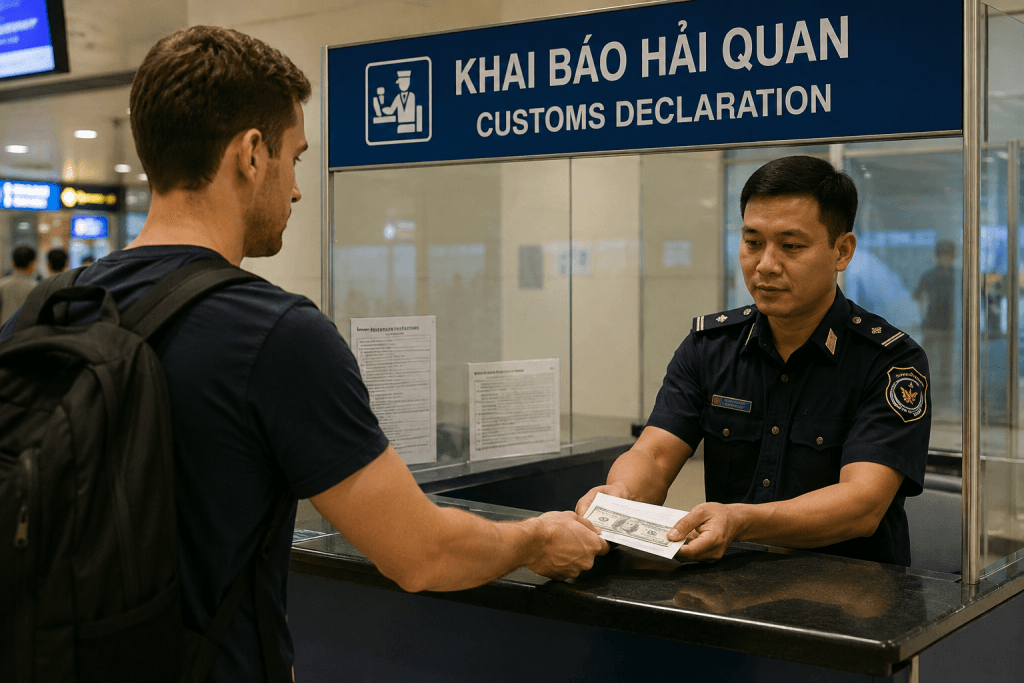
You fill out a customs declaration form and hand it to an officer before leaving the customs area. Forms are available at the customs counter in every international airport, and some airlines hand them out on board before landing. You state the amount in writing, an officer stamps and signs it, and you keep your copy — that stamped form is the document that matters later.
Under the threshold, there is nothing to do at all. You walk through the standard “nothing to declare” channel like any other arriving passenger, and no one asks about cash.
Our team sees this play out most often with golfers who bring a thick stack of USD to cover an entire trip’s tips, meals and green fees, and then worry at the airport for no reason. If that is the situation you are in, our guide to paying for golf in Vietnam covers exactly where card works and where cash is still the norm — it usually turns out far less cash is needed than people pack.
Do the Same Rules Apply When You Leave Vietnam?
Yes — the USD 5,000 and 15,000,000 VND thresholds work identically on departure. This is the half of the rule that barely gets written about, and it matters more than the arrival side for anyone leaving with more money than they came in with, whether from an exchange, a refund, or simply not spending what they budgeted.
If you declared cash on entry and are leaving with the same amount or less, you do not need a new declaration. The stamped entry form covers you — but only within 12 months of the date printed on it. Leave with more than you declared on arrival, or leave over the threshold having declared nothing on the way in, and you need either a bank-issued authorisation or written approval from the State Bank of Vietnam before that money can go out with you.
For a one or two-week trip, none of this normally comes up. The travellers who need to plan ahead are those carrying large sums for a property purchase, a business transaction, or an extended stay.
What Happens If You Do Not Declare?
You face an administrative fine that scales with the size of the undeclared excess. Decree 169/2026/NĐ-CP, in force since 1 July 2026, sets the current penalty bands for customs violations, and it treats exit and entry differently.
| Direction | Fine range (undeclared cash) |
|---|---|
| Leaving Vietnam | Roughly 1,000,000 – 50,000,000 VND |
| Entering Vietnam | Roughly 1,000,000 – 20,000,000 VND |
| How the band is set | By the value of the undeclared excess |
Very large undeclared sums can be referred for criminal prosecution instead of being handled as an administrative fine. The circumstances that trigger that escalation depend on the specifics of the case rather than a clean cash cut-off, so if you think you might be near that territory, that is a question for a customs officer or an immigration lawyer — not something to estimate from a blog post.
Can You Bring Gold Into Vietnam?
Gold sits under a separate and noticeably stricter regime. It is governed by Circular 11/2014/TT-NHNN rather than the cash rule above. Gold jewellery and ornamental gold generally need declaring once the total reaches around 300 grams. Gold bars and raw gold are, as a rule, not permitted to be carried across the border by individuals at all — travellers arriving with bar gold are typically required to place it in a customs bonded warehouse rather than bring it in.
This corner of the regulation has more edge cases than the cash thresholds do, so if gold forms part of your travel plans, treat it as its own question and confirm the current position with customs before you fly.
How Much Cash Does a Golf Trip to Vietnam Actually Need?
Far less than the declaration threshold — for most golfers, a few hundred dollars covers the whole trip. The two genuinely cash-only line items are caddie tips, which are always handed over in Vietnamese dong, and everyday off-course spending in markets, cafés and smaller restaurants. Neither comes close to USD 5,000.
The reason is that the expensive parts are settled before anyone gets on a plane. GoGolfVietnam, a golf tour operator based in Da Nang, pays green fees, caddie fees and transfers directly to the courses and hotels, so a golfer’s cash is only ever needed for tips and incidentals. Our Montgomerie Links stay-and-play itinerary starts at USD 699 per golfer for three nights and two rounds — around one-seventh of the cash declaration threshold, and paid by transfer or card rather than carried through an airport.
One point worth flagging for groups: the USD 5,000 limit applies per traveller, not per fourball. GoGolfVietnam regularly fields this question from groups planning to pool cash for a trip, and the answer is that whoever physically carries the money is the person the threshold applies to. If you want to sanity-check what a trip really costs before deciding how much to bring, our rundown of typical green fee and caddie costs across Vietnam lays out realistic budgets course by course, or you can compare Da Nang golf packages that cover the big costs before you fly.
Frequently Asked Questions
Do I need to declare USD 3,000 when entering Vietnam?
›
No. USD 3,000 sits under the USD 5,000 threshold, so no declaration is required, whether you are entering or leaving the country.
Does the USD 5,000 limit apply per person or per group?
›
Per person. If one traveller in a group is personally carrying more than USD 5,000, that traveller must declare it, regardless of who the money is intended for. Splitting cash so each person stays under the threshold is a common approach, though every traveller remains responsible for what they are actually carrying at the border.
Does the limit cover money on cards or in bank accounts?
›
No. The rule applies only to physical cash on your person or in your luggage. Funds on a debit or credit card, or in an account you access by transfer, are not subject to this declaration threshold.
If I declared cash on arrival, do I have to declare it again when I leave?
›
Not if you are leaving with the same amount or less than you declared on entry — the stamped entry declaration covers you on exit, provided you are within 12 months of the date on that form. Leaving with more than you declared requires separate authorisation.
What is the fine for not declaring cash over the limit?
›
Fines run from roughly 1,000,000 VND up to 50,000,000 VND on exit, and up to 20,000,000 VND on entry, scaled to the size of the undeclared amount under Decree 169/2026/NĐ-CP. Very large sums can escalate beyond an administrative fine, so if you are near the threshold, declare.
Can I bring gold jewellery into Vietnam without declaring it?
›
Gold falls under a separate rule, Circular 11/2014/TT-NHNN, and generally needs declaring once jewellery or ornamental gold totals around 300 grams. Gold bars and raw gold are normally not permitted to be carried in personally and must go into a customs bonded warehouse instead.
GoGolfVietnam is a Da Nang-based golf tour operator arranging stay-and-play trips across Central Vietnam, and we help visiting golfers plan the practical side of a trip — including how much of it actually needs to be paid in cash.
This article is general travel information, not legal or financial advice. Customs regulations change and individual circumstances vary, so anyone carrying cash close to or above these thresholds should confirm the current requirements with Vietnamese customs or their airline before departure.
Get your free personalized itinerary & quote within 1 hour!


