




Last updated: 24 October 2026
You can bring up to USD 5,000 in foreign cash, or 15,000,000 VND, into or out of Vietnam per person without declaring it. Carry more than either amount and you must declare it in writing to customs, on arrival and on departure alike. Most guides stop at the arrivals hall; the exit side is where travellers actually get caught out.
Quick answer
- No form needed: up to USD 5,000 (or the same value in other currencies) and up to 15,000,000 VND, about USD 575.
- Declare: anything above either limit, in writing, on entry and on exit.
- Per person: each traveller has their own limit; families cannot pool it.
- Cash only: cards and bank transfers are not covered.
- Not declaring: fines of up to 50,000,000 VND on exit and 20,000,000 VND on entry since 1 July 2026.
How Much Cash Can You Bring Into Vietnam Without Declaring It?
Two separate thresholds apply, and you only need to declare if you cross one of them. Vietnamese law sets the limit at USD 5,000 in foreign currency cash (or the equivalent in EUR, GBP, AUD, SGD and so on) and 15,000,000 VND in Vietnamese dong. These are independent figures, not a combined allowance: carrying USD 4,000 alongside 10,000,000 VND keeps you under both, and nothing needs declaring.
What you cannot do is borrow headroom from one currency to cover the other. Cross USD 5,000 on its own and a declaration is required, no matter how little dong you have.
| What you are carrying | No declaration needed | Declaration required |
|---|---|---|
| Foreign currency cash (USD or equivalent) | USD 5,000 or less | Over USD 5,000 |
| Vietnamese dong cash | 15,000,000 VND or less | Over 15,000,000 VND |
| Card balance or bank transfer | Any amount | Not covered by this rule |
| Applies to | Each traveller individually | Entry and exit alike |
The legal basis is Circular 15/2011/TT-NHNN of the State Bank of Vietnam, issued on 12 August 2011 and in force since 1 September 2011, which governs how individuals carry foreign currency and dong across the border. You can read the full text of the circular on the Vietnamese Government’s official portal. Vietnamese press reporting in May 2026 confirmed the same thresholds still apply.
What Happens at Arrivals If You Are Over the Limit?
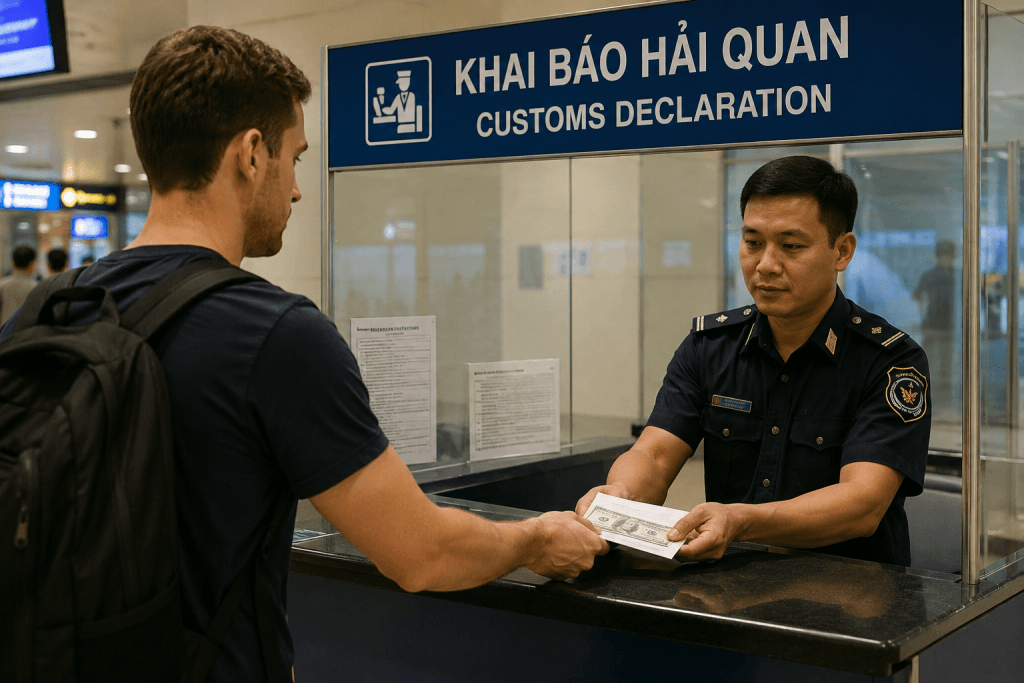
You fill out a customs declaration form and hand it to an officer before leaving the customs area. Forms are available at the customs counter in every international airport, and some airlines hand them out on board before landing. You state the amount in writing, an officer stamps and signs it, and you keep your copy. That stamped form is the document that matters later.
Under the threshold, there is nothing to do at all. You walk through the standard “nothing to declare” channel like any other arriving passenger, and no one asks about cash.
Our team sees this play out most often with golfers who bring a thick stack of USD to cover an entire trip’s tips, meals and green fees, and then worry at the airport for no reason. If that is the situation you are in, our guide to paying for golf in Vietnam covers exactly where card works and where cash is still the norm. It usually turns out far less cash is needed than people pack.
How Much Money Can You Take Out of Vietnam?
The same USD 5,000 and 15,000,000 VND thresholds apply on departure. This is the half of the rule that barely gets written about, and it matters more than the arrival side for anyone leaving with more money than they came in with, whether from an exchange, a refund, or simply not spending what they budgeted.
If you declared cash on entry and are leaving with the same amount or less, you do not need a new declaration. The stamped entry form covers you, but only within 12 months of the date printed on it. Leave with more than you declared on arrival, or leave over the threshold having declared nothing on the way in, and you need either a confirmation letter from a licensed bank or written approval from the State Bank of Vietnam before that money can go out with you.
For a one or two-week trip, none of this normally comes up. The travellers who need to plan ahead are those carrying large sums for a property purchase, a business transaction, or an extended stay.
What Happens If You Do Not Declare?
You face an administrative fine that scales with the value of the undeclared excess. Decree 169/2026/NĐ-CP, issued on 15 May 2026 and in force since 1 July 2026, replaced the earlier customs penalty decree and treats departure more strictly than arrival.
| Direction | Undeclared excess | Fine |
|---|---|---|
| Leaving Vietnam | 5 to under 30 million VND | 1–3 million VND |
| Leaving Vietnam | 30 to under 70 million VND | 5–15 million VND |
| Leaving Vietnam | 70 to under 100 million VND | 15–25 million VND |
| Leaving Vietnam | 100 million VND or more | 30–50 million VND |
| Entering Vietnam | 5 to under 50 million VND | 1–2 million VND |
| Entering Vietnam | 50 to under 100 million VND | 5–10 million VND |
| Entering Vietnam | 100 million VND or more | 10–20 million VND |
Fine bands for individuals as reported from Decree 169/2026/NĐ-CP (CafeF, 20 May 2026; Thanh Niên, 31 May 2026). They apply to undeclared or falsely declared cash and gold.
Very large undeclared sums can be referred for criminal prosecution instead of an administrative fine. If you think you might be near that territory, ask a customs officer or a lawyer rather than estimating from a blog post.
Can You Bring Gold Into Vietnam?
Gold sits under a separate and noticeably stricter regime. It is governed by Circular 11/2014/TT-NHNN rather than the cash rule above. Gold jewellery and ornamental gold must be declared once the total reaches 300 grams. Gold bars and raw gold cannot be carried across the border by individuals at all; travellers arriving with bar gold must place it in a customs warehouse or send it back abroad.
This corner of the regulation has more edge cases than the cash thresholds do, so if gold forms part of your travel plans, treat it as its own question and confirm the current position with customs before you fly.
How Much Cash Does a Golf Trip to Vietnam Actually Need?
Far less than the declaration threshold: for most golfers, a few hundred dollars covers the whole trip. The two genuinely cash-only line items are caddie tips, which are always handed over in Vietnamese dong, and everyday off-course spending in markets, cafés and smaller restaurants. Neither comes close to USD 5,000.
The reason is that the expensive parts are settled before anyone gets on a plane. GoGolfVietnam, a golf tour operator based in Da Nang, pays green fees, caddie fees and transfers directly to the courses and hotels, so a golfer’s cash is only ever needed for tips and incidentals. Our Montgomerie Links stay-and-play itinerary starts at USD 699 per golfer for three nights and two rounds, around one-seventh of the cash declaration threshold, and paid by transfer or card rather than carried through an airport.
One point worth flagging for groups: the USD 5,000 limit applies per traveller, not per fourball. GoGolfVietnam regularly fields this question from groups planning to pool cash for a trip, and the answer is that whoever physically carries the money is the person the threshold applies to. If you want to sanity-check what a trip really costs before deciding how much to bring, our rundown of typical green fee and caddie costs across Vietnam lays out realistic budgets course by course, or you can compare Da Nang golf packages that cover the big costs before you fly.
Frequently Asked Questions
1. Do I need to declare USD 3,000 when entering Vietnam?›
No. USD 3,000 is under the USD 5,000 threshold, so no declaration is needed on entry or exit.
2. Do I need to declare USD 10,000 in Vietnam?›
Yes. USD 10,000 is above the USD 5,000 threshold, so you must declare it in writing to customs when you arrive. Keep the stamped declaration: it lets you take up to the same amount back out within 12 months.
3. Is the cash limit per person or per family?›
Per person. Each traveller has their own USD 5,000 and 15,000,000 VND threshold, and the person physically carrying the cash is the one who must declare it. A family cannot pool its allowances into one bag.
4. Does the limit cover money on cards or in bank accounts?›
No. The rule covers physical cash only. Card balances, bank transfers, traveller’s cheques and similar payment instruments are not part of the cash threshold.
5. Can I take Vietnamese dong out of Vietnam?›
Yes. You can leave with up to 15,000,000 VND (about USD 575) in cash without declaring it. Above that, declare it, and if the amount exceeds what you declared on arrival you also need a bank confirmation or State Bank approval.
6. If I declared cash on arrival, do I have to declare it again when I leave?›
Not if you leave with the same amount or less. Show the stamped entry declaration, which is valid for 12 months from its date. Leaving with more than you declared needs a bank confirmation letter or State Bank approval.
7. What happens if I don’t declare cash in Vietnam?›
You can be fined. Under Decree 169/2026/NĐ-CP, in force since 1 July 2026, an undeclared excess on departure costs 1,000,000 to 50,000,000 VND and on arrival 1,000,000 to 20,000,000 VND, depending on its value. Very large cases can go further.
8. Can I bring gold jewellery into Vietnam without declaring it?›
Yes, below 300 grams. Gold jewellery and ornamental gold of 300 grams or more must be declared under Circular 11/2014/TT-NHNN. Gold bars and raw gold cannot be carried by individuals and must go into a customs warehouse.
GoGolfVietnam is a Da Nang-based golf tour operator arranging stay-and-play trips across Vietnam, and we help visiting golfers plan the practical side of a trip, including how much of it actually needs to be paid in cash.
This article is general travel information, not legal or financial advice. Customs regulations change and individual circumstances vary, so anyone carrying cash close to or above these thresholds should confirm the current requirements with Vietnamese customs or their airline before departure.
Get your free personalized itinerary & quote within 1 hour!


