




Last updated: August 2026
Golden Sands Golf Resort opened its North course on the dunes at Vinh Xuan beach in September 2024, giving Hue a second championship layout after more than a decade with only one. It measures about 7,445 yards from the back tee, and the wind off the East Sea does most of the defending.
Quick answer
Golden Sands is a Nicklaus Design links-style course on the coast about 20 km east of Hue, opened in September 2024 and built by BRG Group. The back nine runs across genuine sand dunes with sea views; the front nine was raised out of low-lying flats and plays flatter. Long, windy and demanding — best suited to mid and low handicappers.
| Course | Golden Sands Golf Resort, North course (also listed as Golden Sands Golf Club) |
| Location | Vinh Thanh, Phu Vang, Hue – about 20 km east of Hue city centre |
| Holes / Par | 18 / 72 |
| Length | About 7,445 yards, par 72 |
| Designer | Jim Wagner, as senior design associate at Nicklaus Design; completed with Sean Quinn |
| Developer | BRG Group |
| Opened | Soft opening September 2024; official opening 28 September 2024 |
| Greens | TifDwarf bermuda, averaging around 750 m² per green |
| Fairways & tees | Greenlees Park couch grass |
| Course style | Coastal links-style over natural dunes, with a retained casuarina line |
| Second course | A South course is in the planning stage |
Why a 2024 Opening Mattered So Much for Hue
Until Golden Sands opened, a golf trip to Hue meant one course. Laguna Golf Lang Co had carried the region alone since 2013, which made Hue a one-round stop on most Central Vietnam itineraries rather than a destination in its own right. A second championship course changes that arithmetic: two quality rounds justify two nights, and two nights change how the whole trip is routed.
BRG Group developed the site along Vinh Xuan beach, and the North course is the first of two Nicklaus Design layouts planned here. Jim Wagner drew it while a senior design associate at Nicklaus Design, with Sean Quinn seeing the work through to completion. BRG has form with the firm — Legend Hill, Kings Island and Da Nang Golf Resort all came out of the same partnership.
The Back Nine Was Found. The Front Nine Was Built.
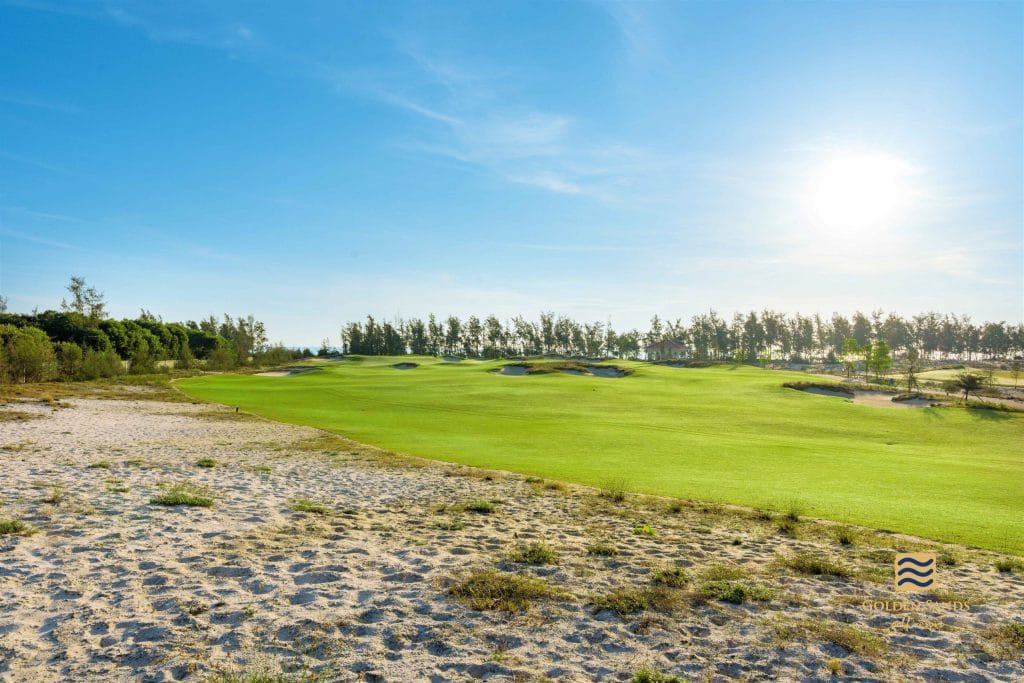
This is the honest split at Golden Sands, and the designer says it plainly himself. Most of the front nine sat on extreme low-lying flats that held water and had to be raised before a single hole could be routed across it. The back nine needed almost none of that — it runs over natural sand dunes and gently rolling ground with the sea to the east.
You feel the difference walking it. The outward half is competent, wide and fair, but it is manufactured ground. From the tenth onward the land does the work. Wagner has called the closing stretch one of the more exciting finishes in Vietnamese golf, and holes thirteen through fifteen are where that claim earns itself: a par three climbing away from the ocean, then the short par-four fourteenth tumbling downhill with the sea filling the horizon behind the green.
A natural ridge running north to south bisects the property and dictated the entire routing. Its high point is where the clubhouse now sits, with the par-five ninth playing back along the ridge into a green below the building.
The Wind Is the Course, and the Yardage Is Not the Whole Story
At about 7,445 yards off the tips, Golden Sands is already long. Add coastal wind and it becomes something else. Wagner has described conditions during construction as days that would have been unplayable, with sand moving across the site, and he is direct that the client asked for a difficult course and got one.
Fairways are genuinely wide, which softens the blow. The trouble is not finding the ball off the tee — it is the second shot. Several greens have large sections pitching away from the player or feeding hard in one direction, so an approach that lands ten feet off line can finish thirty feet away. Into a headwind, aiming at the fat of the green stops being conservative and starts being the only sensible play.
Wagner built long freeform teeing grounds specifically so players can move forward on windy days. Use them. GoGolfVietnam books guests here on the eight-day Central Vietnam itinerary, and the golfers who enjoy the round most are the ones who drop a tee box rather than defend a number on the scorecard.
Where the Round Is Actually Won: Around the Greens
Putting surfaces here average roughly 750 square metres, which is large by any standard, and the sixteenth carries one of the biggest greens Wagner says he has designed. Big greens sound forgiving. They are not, when a good portion of the front section slopes back toward the tee and the pin is cut long.
Approaches are mown tight and the surrounds fall away, so recovery is a choice rather than a reflex. Bump-and-run, a lofted pitch, or putting from off the surface are all live options on the same shot. Golfers who only own one short-game shot will find that out quickly. Greens ran just under 10 on the Stimpmeter when Nicklaus Design measured them shortly before opening.
The par-five seventh is worth flagging. Its green sits in a natural punchbowl below a drop in elevation and is completely blind on the approach, with carry bunkers sitting twenty to thirty yards short. Blind shots divide people. Here it is the most memorable moment on the outward half.
What Golden Sands Is Not
Two things are worth setting straight before anyone books on the strength of the photographs.
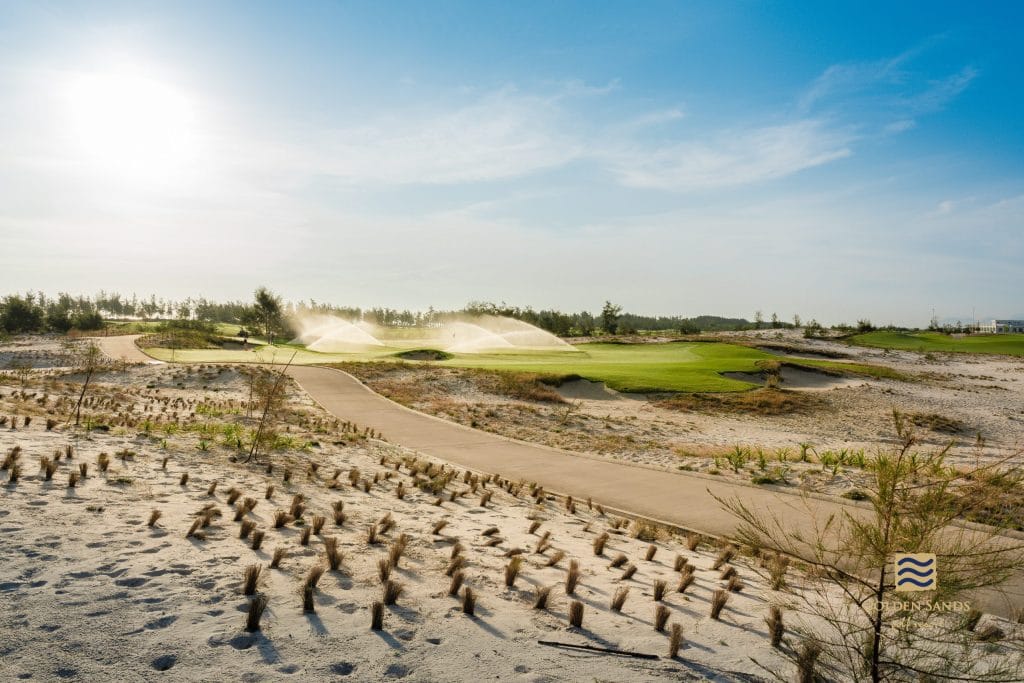
First, no hole runs directly along the beach. Permitting required a line of casuarina trees to be retained between the course and the sand. Nicklaus Design thinned that line and opened sightlines in key spots, and the ocean is genuinely visible from the back nine — but this is a course near the sea rather than one built on the shoreline. Anyone expecting an unbroken beachfront round will be adjusting expectations on the first tee.
Second, it is young. The course opened in September 2024, and the native grasses, sedges and casuarina plantings that give a links its texture need years, not months. What it looks like in 2030 and what it looks like now are two different courses.
Golden Sands or Laguna Lang Co? Choosing Between Hue’s Two Courses
They are not competing for the same golfer, which is the useful part.
Laguna is a Nick Faldo design set between mountain and lagoon, sheltered, scenic and more forgiving on a bad ball-striking day. Golden Sands is longer, more exposed and built to test — the wind is a permanent third element rather than an occasional one. If your group has a spread of handicaps and wants a pleasant round with photographs, Laguna is the safer call, and our hole-by-hole take on Laguna Golf Lang Co covers what to expect there.
If your group plays to single figures and measures a trip by how hard it was, Golden Sands is the better round. Playing both across two nights in Hue is the option we now recommend most often, because the two courses ask completely different questions.
Fitting Golden Sands Into a Central Vietnam Trip
Want the quick specs and current rates before you commit? See the Golden Sands Golf Resort course page for the info table, photo gallery, and booking request form.
Hue sits at the northern end of the Da Nang–Hoi An–Hue golf corridor, and Golden Sands sits further out again on the coast. That makes it a poor choice for a day trip from Da Nang and a good choice as the last round of a longer route heading north.
GoGolfVietnam closes its eight-day itinerary that finishes in Hue here, after six rounds on six different courses — Golden Sands is the only Hue course on that route besides Laguna, and the only one no other Da Nang package includes. For groups building their own schedule, our week-long Central Vietnam golf itinerary shows how the driving days usually fall.
Green fees and tee-time availability at Golden Sands change with season and demand, and as a course still in its first two years the published rates have moved more than once. We confirm the current figure at the time of booking rather than quoting a number that dates. If you would rather compare complete routes, the Central Vietnam golf packages that include the Hue courses lay out what each itinerary covers.
GoGolfVietnam is a golf tour operator based in Da Nang, and we arrange tee times, transfers and accommodation across the Da Nang, Hoi An and Hue courses, including the transfer out to the coast at Vinh Thanh.
Frequently Asked Questions
When did Golden Sands Golf Resort open?
›
The North course held a soft opening in early September 2024 and officially opened on 28 September 2024. A second course, the South, is still in the planning stage.
Who designed Golden Sands Golf Resort?
›
Jim Wagner designed it while a senior design associate at Nicklaus Design, and Sean Quinn helped complete the course. It was developed by Vietnam’s BRG Group and built along Vinh Xuan beach near Hue.
How long is Golden Sands and what is the par?
›
It is an 18-hole par 72 measuring about 7,445 yards from the back tee, with the designer describing it as playing over 7,500 yards from the very back. Long freeform teeing grounds let players move forward, which matters on windy days.
Is Golden Sands a true beachfront course?
›
Not quite. Permitting required a line of casuarina trees to be retained between the course and the beach, so no hole runs directly along the sand. The trees were thinned to open sea views, and the ocean is clearly visible from the back nine.
Golden Sands or Laguna Golf Lang Co — which should I play?
›
Laguna is more sheltered and more forgiving, so it suits mixed-handicap groups. Golden Sands is longer, more exposed and harder, so it suits lower handicappers. Groups spending two nights in Hue increasingly play both.
How far is Golden Sands from Hue and Da Nang?
›
It sits on the coast about 20 km east of Hue city centre, roughly 30 minutes by car, and about 80 km from Da Nang. That distance from Da Nang is why it rarely works as a day trip from there, which is why it usually appears as the closing round of a longer northbound itinerary.
Get your free personalized itinerary & quote within 1 hour!


